210.560.1308
210.560.1308
K9 Trainer Course | Working Dog Development Program
If you are searching for a K9 trainer course, you are likely looking for a way to work with high-drive dogs and develop real-world working K9 skills. Traditional trainer courses often focus on classroom-style instruction, but developing a reliable working dog requires hands-on experience, structure, and the right environment.
At Universal K9, we take a different approach. Instead of operating a traditional trainer course, we focus on K9 Team Development — guiding the development of high-drive dogs alongside the preparation of individuals working with them in real-world scenarios.
What Makes Our Approach Different from a K9 Trainer Course
Unlike a standard K9 trainer course, our program is built around actual working dogs sourced through shelter partnerships. This means the focus is not on theory, but on the evaluation, development, and progression of dogs with real working potential.
• Work with high-drive dogs identified for police and detection work
• Learn evaluation methods based on drive, engagement, and behavior
• Participate in structured development of working K9 candidates
• Understand the progression from shelter dog to deployable K9
• Gain exposure to real-world expectations of law enforcement K9 teams
K9 Team Development Model
Our program operates through partnerships with animal shelters that identify and set aside high-drive dogs. These dogs are developed through a structured process designed to prepare them for independent third-party evaluation and certification.
Individuals involved in the program are guided through this process, gaining practical experience while contributing to the development of working dogs that will ultimately be placed with law enforcement agencies.
From Shelter Dog to Working K9
One of the key differences in our model is the opportunity to be involved in the full development cycle. Dogs are selected based on drive — not breed — and are developed over a 6 to 8 week process into working K9 candidates.
This approach not only provides real experience but also creates a meaningful impact by giving dogs that might otherwise be overlooked a path into service work.
Important Note
Universal K9 does not provide certification of trainers, handlers, or dogs. All certification and qualification is conducted independently through third-party organizations or agencies.
Who This Is For
• Individuals interested in working dog development
• Shelter staff or volunteers seeking to participate in K9 programs
• Agencies exploring working dog partnerships
• Anyone looking for real-world experience beyond a traditional trainer course
Learn More
If you are interested in learning more about how this program works or how to get involved, contact Universal K9 to discuss current opportunities and partnerships.
Participation Requirements
Individuals participating through the K9 Team Development program should:
• Be at least 18 years of age
• Present proof of secondary education (high school diploma or GED certificate)
• Have a strong interest in working dog development
• Be capable of working with high-drive dogs in a structured environment
Program Structure
This is not a traditional classroom-based trainer course. Participation takes place through the K9 Team Development program in partnership with shelters, where individuals are involved in the evaluation, development, and progression of high-drive dogs being prepared for working roles.
Program Cost
Total Cost of Program: $15,000
Availability
Opportunities to participate are limited and are offered through active shelter partnerships or approved placements within the program.
| Subject # | Title | Course Time (Hours) Lecture / Lab (Total) |
|---|---|---|
| TR-01 | Canine Safety & Care | 1 / 9 (10) |
| TR-02 | Dog Selection & Evaluation | 1 / 19 (20) |
| TR-03 | Obedience Training | 4 / 76 (80) |
| TR-04 | Detection Training | 2 / 43 (45) |
| TR-05 | Patrol Training | 2 / 38 (40) |
| TR-06 | Canine Behavioral Modification | 5 / 155 (160) |
| TR-07 | Scent Theory | 2 / 3 (5) |
| TR-08 | Search Patterns | 1 / 4 (5) |
| TR-09 | Trainer / Instructor Teaching Techniques | 1 / 19 (20) |
| TR-10 | Handling Explosives & Narcotics | 1 / 4 (5) |
| TR-11 | Validation & Legal Considerations | 1 / 9 (10) |
| 400 (total) |
Subject Descriptions:10984106_869460616454060_161195763932423222_n
In this subject, students will learn the proper techniques in the following topics which include feeding, kennel care, vet care, medication, safety in transportation, first aid, urgent care, illicit drugs, and proper care of canine equipment. [Prerequisites: none] 10 hours
Topics include standardized evaluation techniques for dog selection, testing and evaluations, and overview of specialty working dog breeds. [Prerequisites: none] 20 hours
In this subject, students will learn the theory and practical applications in obedience training in the following topics which include commands, basic obedience exercises, proper use and functions of canine training equipment, off-leash obedience training, and canine control at a distance training. [Prerequisites: none] 80 hours
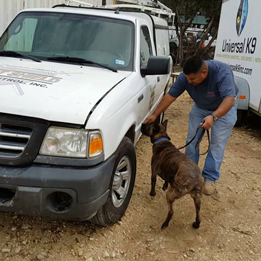
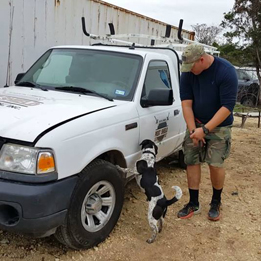
In this subject students will learn the theory and practical applications of canine detection in the following topics which include principles of detection, seek-fetch, types of reward and responses. Students will also be introduced to techniques in handler actions, false response identifications and pinpoint. Students will participate in extensive field work in narcotics & explosives detection. [Prerequisites: none] 45 hours
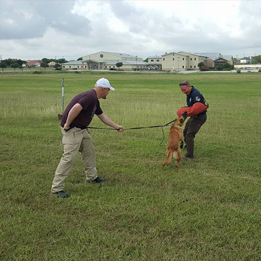
In this subject, students will be introduced to both the theory and practical applications of patrol work and bite work. Topics include controlled aggression with correct positioning and commands, agitation and handler techniques to develop controlled aggression, out, attack ,false run, re-attack, escort, gunfire and cover. Field practical instruction will include student participation in scouting, building searches, decoy techniques for temperament, instinct, prey drive, play drive, defense drive, fight drive, pack drive, nerve strengthening, imprinting, compulsion, anthropomorphism, shaping, rewards, and learning curves. [Prerequisites: none] 40 hours
Focus will be on canine trainer instruction with problematic canine behaviors. Topics include instinct, reward, imprinting, and green dog teaching techniques. Student will be given opportunity to work closely with canines with problem behaviors to directed to problem solving tactics. [Prerequisites: none] 160 hours
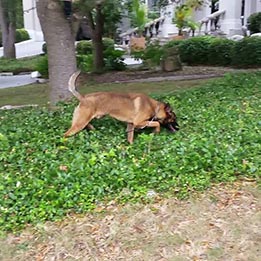
Students will be introduced to canine scent theory, including the mechanics of scent dispersal. Special topics will include canine and climatic effects on canine scent work. Applications to deployment of detection canines and search techniques will be discussed. [Prerequisites: none] 5 hours
Students will be introduced to systematic searches in vehicles, open areas, buildings, luggage and schools. Students will learn specifics of canine handler techniques with bomb threats, VIP sweeps and US Customs searches. Field practical instruction will include participating in actual searches (both narcotics and explosives) in open areas, schools, vehicles, homes, commercial buildings and luggage. [Prerequisites: none] 5 hours
Overview of teaching methods, both classroom field practical training for providing canine trainer instruction. Students will identify and learn how to correct common errors in new canine handlers and best practices for training new handlers. [Prerequisites: none] 20 hours
Student will be instructed in narcotics handling and storage procedures, responsibility, procedures, storage, destruction and control. Students will also be instructed in explosives handling and storage procedures, responsibilities, procedures, storage, destruction and control. [Prerequisites: none] 5 hours
Students will be instructed in methods for validation of a detection canine. Students will discuss legal considerations, including validation, documentation, use of force, and search & seizure concerns. [Prerequisites: none] 10 hours